Your product is changing faster than your team can understand it.
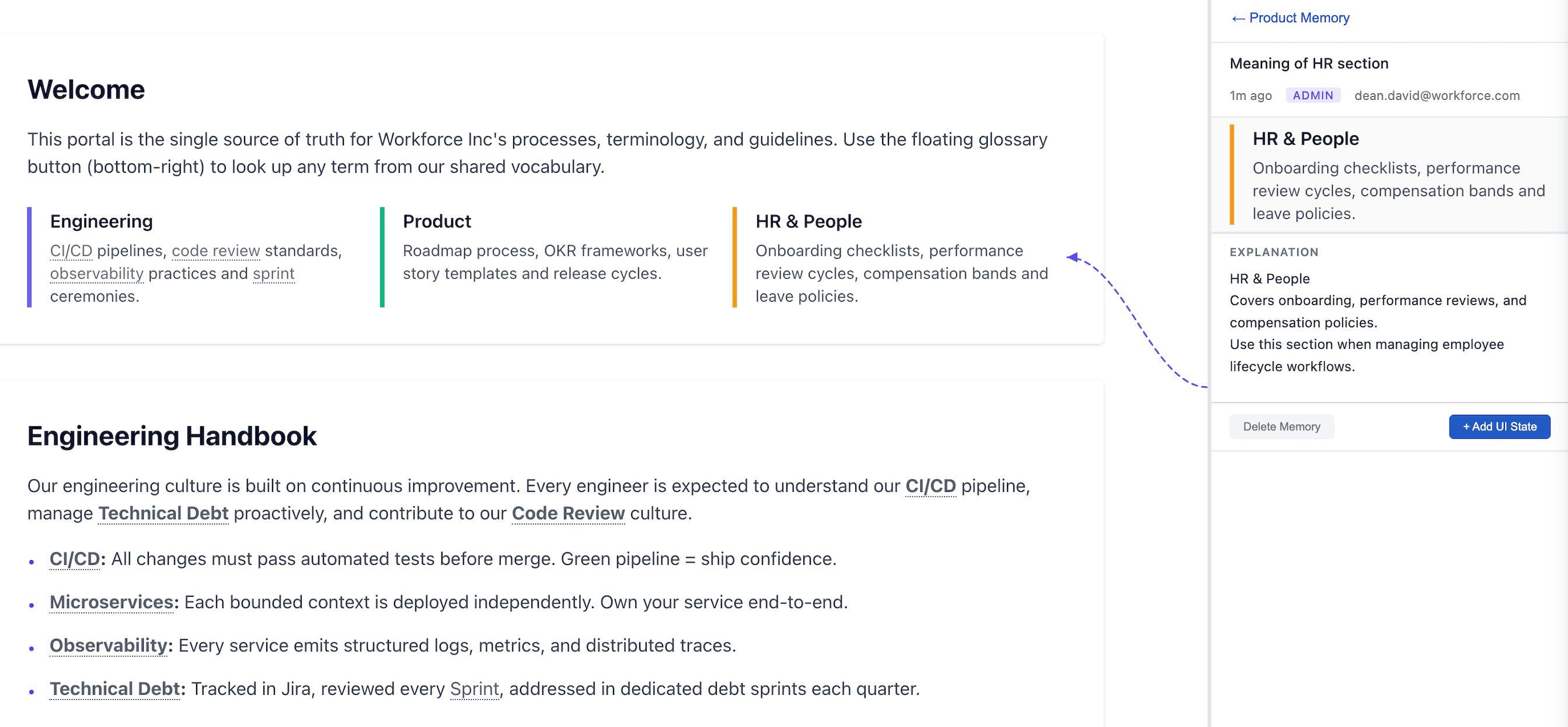
Explanations that live on your product itself, attached to the exact element and state they describe. Your team finds the answer where the question comes up, and asks right there when it isn't covered yet.
Runs inside your existing web app. No switching tabs.
15 MIN · NO PITCH · WE SHOW YOU THE PRODUCT
AI didn't remove the bottleneck. It moved it.
Teams can now produce more software in a week than they used to review in a month. The capacity to understand that software did not change.
- —More gets shipped than any one person reads.
- —So explanation moves into Slack, calls, and the person who remembers. None of it is addressable, and it leaves when they do.
The gap between what your product does and what your team knows it does is comprehension debt. You pay it in rework.
Comprehension debt doesn't announce itself. It sounds like this.
When a developer, tester or product owner is working on a feature—
“Why is this like this?”
“What's supposed to happen here?”
“What does this mean?”
The code shows what your product does. Why it does it lives in someone's head, a closed ticket, or a thread from last spring.
So they:
- —Ask in Slack, or interrupt someone who was mid-task
- —Guess, and move forward on the assumption
- —Ask again next week, because the answer went nowhere
The result
Documentation is a copy of your product.
Unnoodle is a layer on it.
Docs don't go stale because your team is careless. They go stale because of what they are. A doc describes the product from the outside, so shipping changes the product and leaves the doc behind. The gap opens by itself, every release.
Unnoodle doesn't try to win that race. It changes what the explanation is attached to: the element and the state it describes — in the product, pointed at the actual thing.
Nobody has to know the explanation exists, or where it lives. It's where the question is.
Open an explanation and Unnoodle scrolls to the element and draws an arrow to it. No more “the toggle in the top-right of the settings panel.”
Elements resolve by id, then test id, then unique text — and return nothing on ambiguity rather than guessing. If what it described is gone, it stays quiet instead of misleading you.
A glossary is a list of words. This is your product's own states, explained on the states.
What's built, and what isn't.
Today
In your product, now
- —Explanations on the element itself: Unnoodle scrolls to it and points at it
- —Flows formed from how people actually use your product, with nothing to record
- —Questions about your flows and vocabulary, asked and answered in place
- —Terms and UI states, explained on the states themselves
- —A workspace where explanations are written, reviewed and owned
- —Runs inside your web app, added as an npm package
What's next
Explanations you don't have to write
- —AI-written explanations – drafted by Unnoodle, approved by the context's owners before anyone sees them
- —AI-proposed vocabulary – terms and definitions found in your product, confirmed by their owners
- —Agent access – how your product actually behaves and what your team has explained about it, readable by the coding agents you already use. Context that code analysis alone can't provide
Not available yet. Listed so you know where this goes.
Bring us the product your team keeps re-explaining.
Unnoodle is in private beta. We work directly with a small number of product teams (developers, QA and product owners on the same web app). You get the product and our time; we get to build against a real product instead of a hypothesis.
Private beta — we take on a few teams at a time